Monday, 21 October 2013

Where did the week go??

Last week began in an unusual way due to the celebration of Hari Raya Haji, a public holiday, on Tuesday.  Most people also took the Monday off as well, so it felt like a very extended long weekend.

Hari Raya Haji is an important event in the Muslim calendar and commemorates the willingness of Ibrahim to follow Allah's command to sacrifice his son Ishmael.  As Ibrahim was about to kill his son, Allah stopped him and revealed that it was a test, and allowed Ibrahim to sacrifice a ram instead.  So Hari Raya Haji is also known as the Feast of the Sacrifice. During Hari Raya Haji, the sacrifice of four-legged animals such as lambs, goats or cows is performed to commemorate this event.  The animals are killed according to the proper religious rites and meat is then distributed to family, neighbours and to the less fortunate in the community.

In our kampung the sacrifice of around 10 cows happened outside the front gates of Rimbun Dahan, which occurs immediately after the morning prayers, around 9.30am. Families are dressed in their finest clothes and it is an important community event.  I walked to the front gates of Rimbun Dahan with Gabriel, one of the Asialink dancers here, just to have a peek at the (still live) cows, then I quickly went back inside and busied myself with mundane tasks such as washing clothes at the other end of the property, whereas  Gabe stuck it out and took photos and really bonded with the community. So no photos for the blog from me....I'll leave it to your imagination.

The rest of the week I have been stitching away and taking a few last walks around Rimbun Dahan.
I joked that most people will think this is a horticultural residency rather than a textile one, due to all the photos of plants on this blog,  but those of you who know me understand how inspiring nature is to me and my practice, and that it will all eventually evolve either as textile design, natural dyeing or ideas for sculptural objects. So here are a few more spectacular finds in the Rimbun Dahan garden. This Hibiscus mutabilis changes colour from white in the morning to pink in the afternoon and can turn a deep crimson, depending on the temperature.

Hibiscus mutabilis in the taman sari garden
Also found in the taman sari was this spectacular Dillenia philippinensis which is flowering right now.

Dillenia philippinensis front view
Dillenia philippinensis side view
We have had day after day of terrific thunderstorms which have interrupted internet accessibility and efforts to get out of the studio all week, but on Thursday Claire, Sean, their kids and I all piled into the car on an adventure to experience one of the amazing natural wonders in Malaysia - the firefly colonies in Kuala Selangor. I have wanted to see them for the whole three months since I have been here, as we often have several fireflies flitting about the Rimbun Dahan gardens very late at night.  Occasionally as you are walking up the drive from a late night out, you will think it is animal eyes shining in the dark, or something spooky, and then you realise its fireflies, gently dancing along with the moon in their bellies. So I was really keen to see them en masse.


Fireflies, kelip-kelip in Bahasa Malayu, are not flies at all but beetles which belong to the family Lampyridae. You can seen them in large colonies in only two places in the world - Malaysia and Brazil. There are around 2,000 species in the world, and three species live in the Berembang (Mangrove) trees along the Selangor River. Their bioluminescence is used to attract mates, and is a chemical reaction between  four main chemicals of Calcium, Adenosine Triphosphate, Luciferin and Luciferase in the presence of oxygen, inside their abdomen.  


We left Rimbun Dahan at about 5pm and it was starting to sprinkle.  Over the next hour driving north-west we experienced the worst thunderstorm I've ever been in, but Sean was a diligent driver and with Claire navigating in the front and me amusing the kids in the back we eventually made it to a great seafood restaurant to eat dinner (makanan laut) and wait for the storm to pass. Obviously you can't get in a boat to see the fireflies in the rain...to tell you the truth we felt the roads we were driving on were like rivers anyway! Wish we could send all this rain home to you in Australia at the moment.

Unfortunately you cannot use a flash to photograph them on the dark and peaceful journey we took on the battery-powered boat down the river, so I have included these photos from the internet.

http://blog.malaysiajao.com/2013/06/kuala-selangor-fireflies.html
We floated quietly down the river and as we rounded a bend we saw many trees on the banks twinkling and pulsating with tiny Christmas lights - the fireflies! A very magical experience for all of us.

And today I had the rare opportunity to walk through the gardens with Angela, on our way to hunt down an orchid which only flowers for one day. These are the Pigeon Orchids, or Dendrobium crumenatum, which is one of the most widespread species of orchids in Asia. Their flowering cycle is triggered 9 days after a sudden drop in temperature, by at least 5.5 °C or 10 °F, such as after rain.
The purse-shaped spurs on the flowers of Dendrobium crumenatum
It is such a rare treat to walk through the gardens with Angela, who not only knows the scientific names of every plant and tree here, but also its indigenous habitat and if it has medicinal or culinary uses. Outside the Rumah Balai where Gabe and Caitlin are living she pointed out this very strange fruit tree.

Cynometra mallacencis or kekatong
The fruit grow directly from the large trunk and lower branches, and once peeled have a lemony-apple kind of taste and texture, although there is not much flesh, as there is a large kernel inside.

With only a week to go here I have reached a milestone with my work - I have just completed the last of the four large naturally dyed, mordant printed, hand-stitched cloths for my upcoming exhibition. Now this coming week can be devoted to some final dyeing from the plants here for my textiles about Rimbun Dahan, as well as hopefully visiting an institution here that teaches natural dyeing, batik and other crafts.  I will post photos of my work next week, so stay tuned!

sehingga minggu depan
Julie

Sunday, 13 October 2013

Counting down the days

Only two weeks left of my three-month residency, so I have my head down in the studio from early in the morning till late at night in a quiet frenzy to get as much done as possible before I leave. Like most artists and makers, there is never "an end" point.......you just keep making until time or materials run out, or both. Not only am I making work for my upcoming solo exhibition at Narek Galleries in late November, I am also producing work relevant to Rimbun Dahan. In between long periods of sitting still  and stitching, I escape out into the garden to check out what is happening, absorb as much as I can in the time left, and if its not pouring with rain I will swim some laps in the pool to loosen up my neck and shoulder muscles.

When I got back from Pulau Pinang last week I noticed that the fish pond was undergoing renovations again, so it was a chance to get up close and personal to the gorgeous pink and white waterlilies starting to flower.
Still flowering despite lack of water.
And on my way to lunch at the Wayung on Monday I spied these flamboyant Sterculia seed pods on the driveway. I photographed them in situ and took them back to the studio to draw the next day.  However......the next day the black seeds were missing..........sound familiar???? I have read that squirrels like them a lot, and we do have cheeky squirrels that run up the tree next to the studio every morning. Or, it could be another type of culprit......

I think these could be Sterculia parviflora, but I am sure Angela will correct me!
If you read the blog a couple of months ago you will notice the similarity between these pods and the photo of the tropical chestnuts (Scaphium sp.) I posted - they both belong to the mallow family.
Scaphium sp.       Sterculiaceae -  Kembang semangkuk
I feel like I am walking around trying to absorb as much of Rimbun Dahan as I can before I leave. In fact, lucky it was raining on Saturday afternoon because I shed a few tears walking home after lunching at the Warung Seleria Ria. I don't think I have ever eaten at one place so consistently before in my life . I don't even have to order any more - they know my name, what I like to drink, where I like to sit and how much rice (setengah!) I like with nasi campur. When they are closed I eat at Shima Restoran just a bit further up the road, or cook for myself, but I try to avoid that if possible!

Still, wandering up the driveway with tears in my eyes did not blind me to this magnificent piece of architecture high above my head......
Can you believe this nest is only a week old? Approx 70cm long.
This amazing structure is a huge hornet's nest.  I am sorry I could not get any closer to photograph it, but I had just been reading about the recent deaths from killer wasps in China........and then to come back to Rimbun Dahan and find this!  So for the last two days I have been investigating it with my camera, computer and binoculars to ascertain the species.  After hours on the internet and back and forth to the nest I narrowed it down between Vespa affinis (Lesser Banded hornet)  and Vespa tropica (Greater Banded hornet).
I got brave enough to photograph underneath it so you could see the patterning.
I persuaded two visiting musicians to help with identification using the binoculars and all three of us decided that these industrious homemakers are probably Vespa affinis  because it seemed that the yellow banding was in the first two abdominal segments rather than middle.  It was kind of hard to tell really because they kept flying in and out of the nest and we were all a little wary of them coming too close to us!

Musicians, I hear you ask??? Angela has had two musicians from Bali visiting to tune the Rimbun Dahan Gamelan ensemble for an event soon. The Gamelan ensemble is kept in the
balĂ©,  the open-sided studio on the mezzanine above mine, so I have been privy to the intricate processes involved in taking the instruments apart, washing them, sanding and hammering various parts, tuning them and re-positioning them for the last four days.
Gamelan ensemble disassembled and having a nice lie down.
I. Komang Sudirga sanding the bronze saron bars.
I. Komang Sudirga is a talented Balinese musician and composer who kindly gave me a quick overview of the instruments in the ensemble and what was involved in re-tuning them.  Although I am not a musician I was fascinated by the process of aural transformation that occurred from the industrial banging, power-sanding and hammering to the shimmering and exotic tones of gamelan. If you have not experienced the sound of gamelan you can click here to hear a group in Bali rehearsing, very informal and laid back.

I. Wayan Pager sanding the saron bars in order to re-tune them. 

I. Wayan Pager is a very well-known and respected gamelan maker who travels extensively to tune gamelan, and you can read more about him here  - be sure to read the full story. He owns the  Sidha Karya Gong Foundary in Blahbatuh in Bali which has had this review on Trip Advisor.


If you start to research gamelan over the internet you are bound to run into the name of Mantle Hood a pioneer ethnomusicologist in the field of gamelan. His son, Dr Made Mantle Hood, is also a lecturer in ethnomusicology and Indonesian studies, previously at Melbourne Conservatorium of Music but now based at Universiti Putra Malaysia, and made a visit to Komang and Wayan at Rimbun Dahan yesterday.

Our musicians have had to contend with a bit of competition though, which is probably why they tune in the daytime.  I managed to photograph one of the vocalists as it hopped through the studio last night.


Cute, but no, I didn't have time to research frogs as well as hornets and gamelan!! So it remains in cognito!

And speaking of agile and graceful movements, I have yet to introduce the other two Asialink residents here for three months, Caitlin Mackenzie and Gabe Comerford.

Gabe and Caitlin rehearsing in the dance studio at Rimbun Dahan.
They are two young dancers and choreographers based in Brisbane, although Caitlin grew up in Canberra. They are keeping a blog of their residency as well, so those of you interested in what they are doing click here.

Now, despite my first paragraph I know you are thinking where are images of the work I profess to be making.  Well, believe me I have been sewing up a storm, but with my exhibition opening in about 6 weeks I do not want to put up images of the work just yet, I would like to save them for the opening.  There will be a forthcoming article about the exhibition in the upcoming December issue of  Textile Fibre Forum and I will be at tutor  at the Geelong Forum in September 2014, which is also on the website.

I will share with you a book Angela has loaned me (to add to the 1.2 metres of books already piled on my apartment floor to read...!) and which I promptly ordered online. It is "Interwoven Globe: The Worldwide Textile Trade 1500-1800" and it accompanies an eponymous exhibition at the Metropolitan Museum of Art.

Interwoven Globe exhibition Catalogue.
I have already read the chapter on the trade in natural dyes, but the beauty is all the work in this exhibition is naturally dyed, because it is all pre-1856. I love the cloth cover on the catalogue and just wish I could get over to New York to see the exhibition and the public programs.  Alas, too much to do back in Australia.

Anyway, time to start stitching again, 
sehingga minggu depan,
Julie

Monday, 7 October 2013

Pulau Pinang

Conscious that my residency time is quickly disappearing, I took time out this week to visit Pulau Pinang (Penang Island) for a couple of days.  When I applied for a residency through Asialink last year there were two options for arts residencies in Malaysia - Rimbun Dahan and Hotel Penaga.  Both of these residencies are run by the owners of Rimbun Dahan, but obviously are very different from each other in location, facilities and environment. My project was geared very much towards the Rimbun Dahan residency, which I fortunately received, but I was still keen to see what the other studio and accommodation entailed. I stayed at the wonderful Hotel Penaga, and was really made to feel welcome by the friendly staff.  As a textile designer I also appreciated the effort that had gone into selecting the original paintings, old maps, eclectic furniture in the rooms and decorative tiling in the luxurious bathroom...I almost didn't want to leave!


This year there is also another residency available in Penang - Cherrycake Studios.  Tim Craker has also been a Rimbun Dahan artist in residence -  he was a delight to meet in person, an hospitable host, and I also spied his distinctive artwork around George Town.
View of the working space on the first floor, Cherrycake Studio.
Penang lies off the northwest coast of Malaysia and has a fascinating history.  Those of you who have been following the blog will know I have been dyeing fabrics with the Areca nut, which comes from the Pinang Palm, after which the island is named.  However, it had also been briefly called Prince of Wales Island (after King George III) in the mid-18th century by Francis Light, although this name never caught on.
Corner of Lebuh Armenian and Lebuh Cannon
In order to get a handle on the history and architecture of Penang I took a wonderful walking tour with Joann Khaw, a UNESCO Cultural Heritage Specialist Guide. Her knowledge and passion about Penang Heritage architecture, the importance of feng shui in building concepts and interior architecture and fittings, as well as her great sense of humour enabled me to appreciate the differences in shophouse styles from 1790 - 1970's, and why Penang is now UNESCO listed. I also took Joann's tour of the Cheong Fatt Tze Mansion (also known as the Blue Mansion) where this enterprising Chinese housed his 8 wives and their children as well as his business.
Front verandah of the Blue Mansion
Joann gave such a comprehensive tour of the layout of this house that when I visited the Peranakan Museum Mansion I could pay more attention to details and objects of the era, such as the wall frescos and belongings of the past inhabitants, the Babas and Nyonyas, or Straits Chinese.
One of the original frescos on the wall in the Peranakan Museum
Content of a typical needlework box
Chinese women were expected to embroider a pair of beaded shoes for their prospective mother-in-law as part of their dowry, as well as other accomplishments. 

The area around Lebuh Armenian has become famous for its street art, in particular the paintings by Ernest Zacharevic.  The wet season in Penang did not allow me to get around to see every one of them but there is a very informative brochure about the street art in Penang available as a guide.
Kids on A Bicycle, Lebuh Armenian, Ernest Zacharevic.
It was also hard to get a clear photograph due to the hoards of tourists taking their photos with the art.

My stay in Penang coincided with the opening of the new Batik Painting Museum (website currently under construction) at 19 Armenian Street. This Museum focuses on batik as a fine art, rather than as surface design for textiles, and has many paintings by the renowned Dato Cheah Thean Teng as well as other artists such as Khalil Ibrahim, as well as fantastic batik by Ismail Mat Hussin, Chuah Seon Keng and Ida Hadjar.
Modern, light filled gallery of the Batik Painting Museum
The Museum is spread over three floors and still needs some finishing touches such as labelling all the exhibits, but it was a great cross-section of batik as fine art.
Untitled (1994) by Ida Hadjar
Unfortunately not credited.
Joann also took me to an amazing shop that has sold pigments, paints and dyes for generations, Lim Teck Lee. You would not guess the treasures that lay behind the smoked glass facade of their office, and I would never have found it by myself. Thanks Joann!

Penang also has a lovely eclectic mix of old and new, with bowerbird-type gift shops springing up around Lebuh Cina, such as Gallery 29 owned by a Malaysian textile designer, Rebecca Duckett. She and her husband also own the renowned Tropical Spice Garden, which is a must on the Penang agenda. In colonial times Penang built its wealth on its trade in spices - mace, nutmeg, cinnamon, pepper, betel nut from the Pinang Palm - opium, tin and rice. The Tropical Spice Garden is an aromatic way to absorb this history, and they offer cooking classes too! Here is something I have eaten a lot of in kuih  (cakes) since being in Malaysia but had no idea what it looked like - the Pandan plant.

Pandan growing by the ornamental pond.
Which brings me to one of the most important tourist attractions of Pulau Pinang....FOOD! So many choices and so few mealtimes!! From Char Kway Teow, to Penang Laksa; roti canai to mee goreng, nonya cuisine, satay, cendol.....it is overwhelming and a task in itself to find "the best"....everyone you ask has a different opinion of where to find the best food in Penang.  I will not leave you in the lurch though.  My favourite eating place turned out to be Tek Sen in Labuh Carnavon.  It was so good I ate lunch AND dinner there in one day (if only it was open for breakfast too!). One of the dishes on their menu I have since cooked myself are stir-fried winged beans, so crunchy and great to look at too. Known in Malay as kacang botol, these beans are high in protein and vitamins and all parts of the plant are edible, from the seeds to the pods, leaves and flowers.
Kacang botol, or winged beans.
And to round off my amazing time in Penang, what better way than to unwind with a bit of late-night Jazz at the China House in Lebuh Cina, with the smooth sounds of the Northern Jazz Unit accompanied by the sultry vocals of Vivien Adram.
Jazz in the Canteen at China House.
On that soulful note,
sehingga minggu depan
Julie

Sunday, 29 September 2013

Tales, Trails and Travels

This week I escaped from the kampung to see a little more of Malaysian culture and to take the opportunity to track down something I've been looking forward to seeing for several years.....
First stop was KL to the Muzium Negara, which celebrates its 50th anniversary in this location this year, and another trip to the Muzium Tekstil Negara.  In both museums I was particularly interested in the crafts of the orang asli, the indigenous people of Peninsular Malaysia. Officially there 18 tribes which comprise three groups: the Semang,  the Senoi and the Proto-Malay. Here is a detail of a Mah-Meri (Senoi) women's skirt made of origami mengkuang leaves.
Origami skirt worn over a bark cloth skirt made from Terap tree.
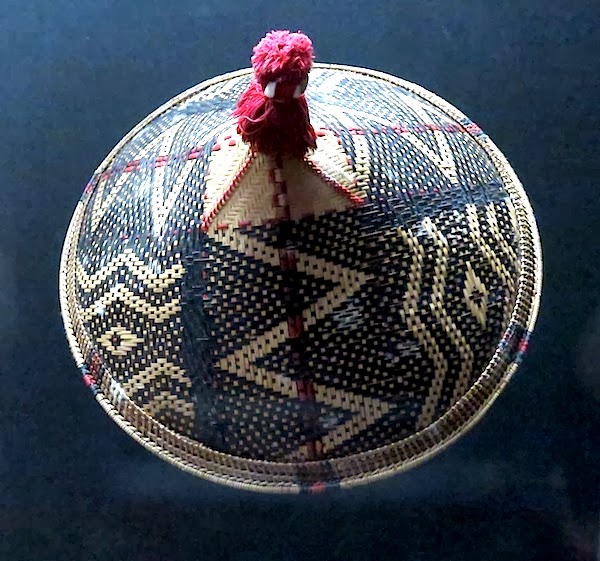
Origami ornaments such as headdress, shoulder sash and cummerbund are also worn. Another display of intricately woven hats caught my eye.  Unfortunately no information about them on the display.

FInely woven hast with bright red pom-poms
From KL I caught the bus to the Cameron Highlands with two items on my agenda - the first to walk the final trail taken by missing textile designer Jim Thompson, and the second to finally come face to face with the Rafflesia,  the largest flower in the world. 

The Cameron Highlands occupies an area the size of Singapore, and are situated 200km from Kuala Lumpur in Pehang, bordering Perak. They are the highest point in Malaysia - 1135 to1839m above sea level - and are therefore a popular cool climate destination for nationals and tourists alike and are the site of many large tea plantations. The bus ride there can be a terrifying 4 hour ordeal, on very windy narrow roads with fearless bus drivers overtaking anything and everything on the way. Needless to say, not pleasant for those who suffer from motion sickness (or for those who don't!).  The best way to get through it is probably close your eyes and ears and try to sleep as soon as possible. 

View of one of the Boh Tea plantations
Jim Thompson was an American businessman who revitalized the Thai silk industry in the 50's and 60's, saving it from extinction. Although his work lives on, he himself disappeared whilst on a trip to the Cameron Highlands in March 1967.  After attending a church service in the morning, he left Moonlight Cottage in the afternoon for a stroll.  
This is Sunlight Bungalow, Moonlight Bungalow in the background.
Although he knew the area well, and was a keen walker, no trace of him was ever found.  Several theories exist - that he was eaten by tigers; that he had been kidnapped by communists; that he was a victim of a hit-and-run accident and his body hidden; that he was killed by an orang asli trap; that he had planned his own disappearance or even committed suicide. Unfortunately we may never know as no trace of him could be found despite hiring groups of orang asli  trackers, police, military, and foreign experts. The two cottages that he and his friends occupied that weekend - Moonlight and Sunlight Bungalows - have new owners who do not allow visitors in, although you can rent them to stay in, although at the time of my visit they were still undergoing renovations.

We were not allowed past the Sunlight Bungalow unfortunately.
 There was no silken thread to follow down that trail, so I then went in pursuit of the Rafflesia that I had really wanted to see last year when I was in Sarawak. To find the Rafflesia you must book to an organised trek with a tour guide, as these plants are found deep within orang asli land.  We drove for about an hour to get to the kampung and then the walk into the jungle was a hot and humid hour and a half. The orang asli scout out flowering Rafflesia for the trekking companies, and this eco-tourism has now become a valuable source of income for their kampung. High priority is placed on not disturbing the environment as we trek in and out in order to preserve it for the future.
Yes, I do know which is the more stunning redhead!
More information about the Rafflesia can be found here but basically this Southeast Asian plant is parasitic on the members of the genus Tetrastigma.  It has no roots or leaves and lives unobserved inside the stems and roots of its host.  It only becomes visible when the buds break through the bark and develop into the largest single flower in the world.  

A view inside the Rafflesia
This Rafflesia is probably Rafflesia arnoldii  (there are 28 species of Rafflesia)  and it was around two days old when we came to meet it.  It is more commonly known as the 'corpse-flower' because it exudes a distinct dead meat smell in order to attract its pollinators, the carrion flies. I did put my nose inside and it had a very funky smell, although this gets stronger at night.

Beautiful ornamentation on the inside and on the 'petals'
Nearby we found another bud getting ready to unfold, although that would probably take a few more months, as they take up to a year to develop. 
Rafflesia bud getting ready to open.
I caught the fast train back to Sungai Buloh from Ipoh, in Perak which developed during the 19th century through tin mining.  It has some lovely old Straits Chinese shop-houses, although many in Old Ipoh are derelict and look ripe for demolition.  However, there were a few trendy cafes that had managed to keep the old facades and embrace the new on the inside.
Old town Ipoh kedai
Back in Rimbun Dahan I found this banana flower which had broken off in the wind. I love it's sculptural form and rich colours.
The banana flower, or bunga pisang.
I was also back in time for a large dinner party with some visitors from the Singapore Botanic Gardens. It was also time to say good-bye to Carlo Gernale, who has finished his 3-month residency and flies back to the Philipines. Selamat tinggal, kawan saya.

sehingga minggu depan
Julie

Monday, 23 September 2013

Warna-warna Malaysia!

Colours of Malaysia! 
We had a public holiday for Malaysia Day last week and I spent the whole day dyeing fabrics from several of the plants I had previously tested.
Natural dyes from the RImbun Dahan garden
If you have been following the blog you will know that I have been testing two different types of alum mordants - Potassium aluminium sulphate and Symplocos, a plant bio-accumulator of aluminium. As you can see from the above photo, there are doubles of each fabric type in each colour in the front row. As I had never used the Symplocos before I was really testing it for my own peace of mind to see how it mustered up against PAS. My results above show there is absolutely no difference between the pairs of samples to the naked eye. The fabrics in the back row are more naturally-dyed swatches not included in the tests. During my last month here I will continue dyeing fabrics that will eventually be used for Rimbun-inspired artworks.

I have also been sketching an painting some of the unusual flora in the taman sari


However, for colour you just can't get any better than an art opening, and in particular the opening of the Art Expo Malaysia 2013. Now in its seventh year, it showcases hundreds of artists from all over the world (except Australia) and this year included works by Picasso, Miro, Yayoi Kusama and Damien Hirst to name a few.
Filipino artist Carlo Gernale and I at the VIP Preview 
I was lucky enough to be invited to the VIP Preview opening through Carlo's friend, Malaysian artist Seah Ze Lin, who had work in the g13 Gallery stand.  Zelin also shows work at Taksu Gallery.

Zelin and his wife in front of his work at g13 gallery stand.
I have to say that my eyes were constantly diverted from the artworks by the colourful and artrageously dressed crowd! However I was inspired by several artists work and the 'bucket men' gouaches by Jui-Pin Chang were drawing a steady crowd.  This one caught my eye for obvious reasons....

Jui-Pin Chan's rendition of Australian $100 note, gouache on P-Tex.

Prior to the opening we were invited to eat at the cutest little cafe in Kuala Lumpur, poco homemade.
poco homemade
This Japanese-inspired cafe is owned by Zelin's wife who makes all the delicious cakes, as well as the quirky artwork and bowerbird collections inside.  I felt like I was back in Gertrude Street, Melbourne or in the Lonsdale Street Traders in Canberra. But better food!
Ice's artworks adorn the walls along with eclectic secondhand treasures.
What better way to finish off this week's blog than with the illuminating display of lanterns at Rimbun Dahan to celebrate the Mid-Autumn Moon Festival. The children lead a colourful procession while we sat and ate mooncakes.
Colourful animal lanterns resting beneath the feet of a well-known Australian artist incognito
Happy Mid-Autumn Moon Festival!
Next week I will be travelling to other parts of Malaysia and hoping to find a trace of missing textile designer and entrepreneur Jim Thompson in the Cameron Highlands.

Sehingga minggu depan,
Julie