Showing posts with label mordant printing. Show all posts

Monday, 25 March 2019

Parallels and Intersections

On March 8th I had the pleasure of giving an artist talk on International Women's Day at my solo exhibition 'The Hidden Sex' at Craft ACT. I highlighted the role of women in the discovery and collection of Australian macroalgae, and the way many women's careers had been submerged due to their gender. That very afternoon I was winging my way to Brisbane to attend the opening of 'Parallel', a weaving and natural dye exhibition by Australian weaver, Kay Faulkner and US weaver and my natural dye teacher and mentor, Catharine Ellis at the Redlands Art Gallery, Cleveland.

Kay Faulkner and Catharine Ellis at 'Parallel' opening
Kay and Catharine have been working independently on dyeing woven cloth using shibori techniques for many years.  In 1998 they both presented at a Convergence conference - Kay with her "Controlled Loom Weaving" and Catharine with "Woven Shibori". They were astounded to find that they had each been interested in exploring the same technique on opposite sides of the world, and hence a true professional and personal friendship was born. I will be writing a review of 'Parallel' for the Textile Fibre Forum magazine in the coming months.
 
Catharine Ellis - Woven shibori in Weld dyebath

Kay Faulkner - detail of "Give them Voice"
I first met Catharine in 2012, when I undertook an intensive workshop with her and Joy Boutrup at Penland in North Carolina on 'The Art and Science of Natural Dyes'. What I was most interested in was the application of mordants and natural dyeing for direct printing, and since 2012 this is what I have based my dye and print practice on in order to produce work for exhibition and teaching what I have discovered along the way. I owe my deeper understanding of the chemistry and its application to natural dyeing to both Catharine and Joy, and, as many of my students will testify, I have always encouraged others to seek this dynamic duo out if they ever get the chance to attend one of their workshops. Catharine and Joy have now published a technical book through Schiffer, and this is now my new 'bible'. What I love about this book is it is not a 'pretty coffee table book' like so many others on the market at the moment- it is truly something you can turn to to get the answers and recipes you need for natural dyes and mordants.

So, with my personally delivered copy of the book from Catharine under my arm, I set forth to teach at Grampians Texture in hall's Gap, Victoria.  This was my first time teaching here and it does not follow the usual format of the other residential workshops I am known to teach in.  Students and tutors do not live in the one place, and instead are scattered throughout the picturesque and magnificent towering cliffs of the Grampians. Classrooms are also similarly dispersed, but we all manage to get together at some point during the artist slide nights, or a casual (yet competitive) game of petanque!!

View of the Grampians from the Information Centre
Staying in one of the many caravan park resorts we were surrounded by all manner of flora and fauna.  Many a night I was woken by the cough coughing of a huge kangaroo outside my hut window, or the surprise of seeing a deer with her faun as we drove into the resort at dusk.
Birds of all descriptions made themselves at home on our verandah, which amused our international tutors no end. Of course, the down side was the need to be vigilant and drive really slowly at all times because the kangaroos rule around here, and when they decide they want to cross the road, you just have to be prepared to stop.
My class was full very early on in the registration period, and I got used to other students coming up to me saying they tried to enrol but missed out.  I had a wonderful group of women and we were lucky to each have a table to ourselves to work on in a huge hall with kitchen.  The first two days are often the hardest for students new to the concepts of mordant printing, mordant strengths and natural dyes, but once we started the dyeing process, the lights go on and they are all hooked!
Naturally dyed and mordant printed by Althea H.

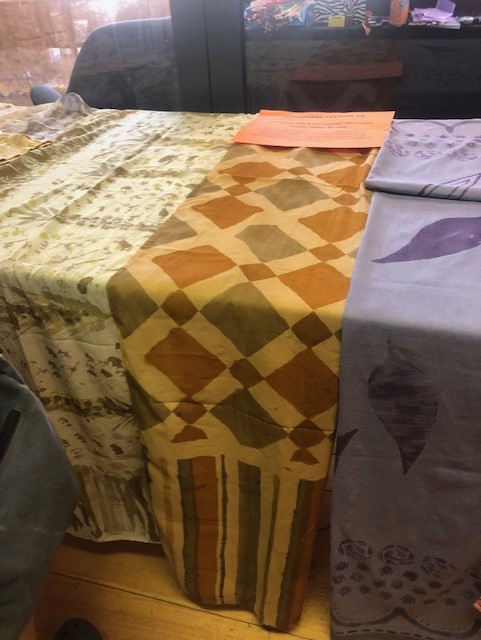
Naturally dyed and mordant printed by Christine McR (left - weld) and Lodi L (right - madder).


Scarves by Carole M (left -weld), Cheryl C (centre - onion skins) and Diane M (right - logwood)

My photos don't do justice to the wonderful work the students managed to achieve but I was very proud of them all, and I hope to see more of their work in the future.

My next upcoming workshop will be a Textile Printing using Photographic Stencils workshop in Ballarat in late June. For more details click here, and an Indigo Resist and Shibori workshop in Mittagong for the Sturt Winter School, click here

All upcoming events and workshops are also listed on my Website


Sunday, 28 January 2018

2018 Workshops and News

I could tell 2018 was going to be a busy year when it started off with a full class at Sturt Summer School. I had a great bunch of students, some of whom had never done any textile dyeing before, so I was really happy with the outcomes, and they were happy to learn all about printing with mordants.

Happy smiles all round! the Mordant Printing Class of 2018 at Sturt.
Since then I have been contacted by several Textile groups in various parts of Australia for some private workshops and I have finally (!) put some of my own workshops up on my website.

Organic indigo vat and resist printing and intro to shibori workshop
First cab off the rank will be an organic indigo and resist printing workshop  24th and 25th February - more information can be found here
Explore the local area, forage for dye plants that reflect the terrain
On 11 & 12 August a new workshop entitled "Local Colour & Dye" will combine foraging for plant materials and using scraps from the kitchen to create wonderful complex colours. Click here for more information.
Learn how to print with mordants to achieve a variety of colours and tones in
the one natural dyebath.
And lastly, the ever-popular Introduction to Mordant Printing workshop will take place on 8 & 9 September. More information here.

I will be overseas in the middle of the year undertaking two arts residencies - more about that exciting news closer to the time!

I hope you make 2018 a year to explore your creativity and connect with like-minded people who share your passion for textiles!
Best wishes
Julie

Friday, 12 January 2018

To Scour or not to Scour? A Galling question....

2018 was off to a good start as soon as I unloaded my van in preparation for the Sturt Summer School. I had a full class of students eager to learn the basics of natural dyeing and then to progress to mordant printing.

One of the most important aspects of all dyeing is the preparation of the cloth beforehand.  All too often we are in such a hurry, we misinterpret 'scouring' to mean "a quick rinse or wash in the washing machine".  Whilst any preparation has to be better than nothing on store-bought fabric, failure to take the time to ensure the fabric is free from grease, oils, dirt and sizing will result in patchy and uneven dyeing, leading to disappointment and waste of time and materials.

Below is a photo of already-whiter-than-white PFP (Prepared for Printing) linen tea-towels that I buy to print on with pigments. The water-based printing emulsion is mixed with concentrated fabric pigments which are screen-printed with a design. Once perfectly dry, the tea-towels are heat-set to bond the resin-based print-paste to the fabric.  It will only ever sit on the surface of the fabric, not inside the fibres as in dyeing.

However, in order to dye these tea-towels (in either natural or synthetic dyes) they must be scoured thoroughly first.  I figured not much would happen but at least I was doing a practical demonstration of the scouring process to the students, most of whom were beginners. 

Was I wrong!! The photo below shows the water that the 5 teatowels were scoured in - can you believe the colour of it - almost looks like a dye itself!!! After this photo was taken I started the process again and scoured the tea-towels a second time. The second lot of scouring water was paler than the first, but not entirely clean.  Given that each scouring should take around 2 hours, we rinsed them and went onto Galling the linen in a Gall Nut soak before we could mordant them the following day. This demonstration clearly shows that whilst the linen tea-towels may be PFP, they are not PFD (Prepared for Dyeing). This is an important distinction if you are buying fabric from a wholesaler to dye with.

Scouring water from the white linen tea-towels
Another important process in fibre preparation for immerse dyeing that is commonly omitted for cotton is the galling or tanning of the fabric or fibre before dyeing. This process literally 'tans' the cloth so that the mordant will attach more readily to the fibre, which in turn attracts the dye. I must admit that I have been a culprit in the past, but Joy Boutrup and Catharine Ellis converted me to galling  cotton when I attended a two week intensive course with them back in 2013. Galling can be done with a number of different plants but I prefer to use the Gall Nut method as it is fairly colourless.

I set up several experiments using store-bought tabby weave cotton fabric;  fabric that had been untreated and unwashed; fabric that had been unwashed, unscoured but mordanted in alum;  fabric that had been scoured and mordanted in alum; fabric that had been scoured and mordanted in Symplocos; and fabric that had been scoured, tanned in Gall Nut and then mordanted in Symplocos. We then dyed the pieces of fabric in a Weld extract dyebath for one hour and observed the differences between them once the samples had been washed, dried and ironed. 

The richest colour and most evenly dyed sample was, not surprisingly, the one that had been scoured, tanned and mordanted in Symplocos.  About one shade behind were the scoured and mordanted samples and the cloth that had been neither washed, scoured nor mordanted was the worst dyed sample of the lot. The differences were easily seen by eye, however did not really show up on camera, hence no photos.

In theory we should also have done a test that included a step with Turkey Red oil for the cotton, but in a 4-day workshop this was unfortunately one step too many!

In my next post I will show some examples of what the student's achieved in the four days, or if you are on Instagram I have posted a few of them @julierydertextiles.

Thursday, 28 September 2017

Mordant printing frenzy!

I really enjoy teaching workshops on natural dyeing because I get such a buzz from inspiring people to look at nature in a different way, to learn more about the plants they use and exploring the many and varied ways to utilise natural colour for our enjoyment. However, when I am teaching I rarely get time to explore new techniques myself.  So it was with great anticipation that my good friend, Sylvia Riley from Sydney, came up to Canberra for a long weekend so that we could have a print-fest at Megalo! Having her there enabled me to print the full width of fabrics on my textile screens - around 140cm wide.
Squeegee passing with my print-pal, Sylvia, at Megalo
Megalo is such a great place to print because it has a full-width 8m table 👏 We both managed to get metres of fabric printed, although we were exhausted at the end of it.  My meterage is to be used for one-off naturally dyed and stitched scarves for the upcoming Open Studio Day.
Different mordants printed onto cotton
The only trouble with mordant printing is that when they dry, they are almost invisible, such as the alum above.  The slightly stained part of the design is a very weak iron and alum mix. All the mordants are printed and aged before dyeing.
Process from print to dyed fabric using a range of mordants.
The first dyebath I put this mordant-printed scarf length into was Acacia catechu, or Cutch. This gave me a lovely range of browns and tans, however I felt the scarf was a little 'dull' so once I washed and ironed it, I over-printed with some alum and another iron mix.
Adding more detail to the scarf with new mordants

Barely visible now but will show up in the next dyeing.

These small prints will add further highlights once I dye in my second dyebath, Rajentot.  I am waiting for this mordant to dry as we speak and will show the finished cloth in a few days time.
By the way, I am teaching an intermediate class on repeat printing at Megalo for the next two Saturdays, more details click here.

Monday, 28 August 2017

Over to the Dark Side....

Wow, I have no idea where July and August went but we are almost into September and I thought I had better do an update on my blog. A couple of weekends ago I ran an Introduction to Natural dyes and Printing with Mordants workshop in Canberra which was well attended, including several participants who have continued to come along to build up their knowledge and skills of natural dyes. It was especially lovely that Pirjo came all the way from Darwin and braved the Canberra winter, lucky it wasn't the weekend just gone because we had both hail and snow here on Sunday.

Making the mordant mixtures for printing
The lovely part about running the workshops is that we have a large kitchen with an open fire blazing away, so we can relax and eat yummy lunches and chat about our natural dye experiences. These conversations always seem to come back to the same gentle admonishments of why I am not on Facebook/Instagram etc etc etc.....

So....in order to keep Belinda, Jess and Ellen quiet....I now have an Instagram account : #julierydertextiles. And to be perfectly honest, I am enjoying connecting with other people, although because I am new to Instagram I am still learning Insta-etiquette. As Ellen commented, I have now crossed over to the Dark Side! So I am determined to show them I am not the luddite they think I am! Actually its more about finding the time to upkeep, but please connect with me on Instagram if you can.

Sunday, 17 April 2016

More Mordant Printing

Here are some more photos of the work produced  during the Fibre Arts Workshop in Ballarat a cou-ple of weeks ago (see previous post). These were taken by Gaye, who thankfully had the presence of mind to remember to take them. As usual I got so busy I forgot to do it myself! This first photo is really interesting because we were all trying to take photos of the table runner we made, but only Gaye's phone (on the right) took a photo of the true colours.

Colour differences between phone cameras (Photo: G Nieuwenhof)

Student's Finished work (Photo: G Nieuwenhof)

Beautiful colour ranges (Photo: G Nieuwenhof)

Lots of pattern and layering to build up texture and colour (Photo: G Nieuwenhof)

Saturday, 16 April 2016

Natural Dye Workshop @ Ballarat

Had a fantastic week in Ballarat with Fibre Arts Australia printing with mordants and dyeing with a variety of natural dyes, from fresh plant material,  powdered dyes as well as extracts. I had a wonderful group of students who were right on track to learn new ways of creating images and colour combinations by printing with mordants both before and after dyeing with natural dyes.  I think we worked out that we had made over 150 colours during the course of the week.....so all the students have built up a wonderful resource for their future forays into natural dyes.  Towards the end of the week our group had to make something for the "top table" so we decided to make this fabulous table-runner which we printed with mordants and then dyed in iris leaves.
Table runner after printing with various mordants (before dyeing)
We were all so proud of it and we raised $100 when it sold to one of the other tutors during the live auction.
Table runner after dyeing with iris leaves and decoratively stitched by students
After the workshop I had several enthusiastic emails from several of my class saying they had already started putting their new skills into practice.  That is so exciting for me as a teacher - to know that you have not only inspired others with your passion and knowledge but also to create the impetus for independant research and experimentation.

The Ballarat Class of 2016 - Awesome and talented ladies!!

Thank you all so much for a wonderfully calm and productive week!

Thursday, 17 March 2016

A Collection

To coincide with the Fibre Arts@Ballarat workshops this year there will be an exhibition of tutor's work entitled A Collection at The Lost Ones Gallery in Camp Street Ballarat from 16 March to 3rd April.
View of exhibition at the Lost Ones Gallery
This exhibition has been curated by Tara Poole from RIIS Strategic Consulting and will provide a wonderful snapshot of the talent and creativity of the tutors at this year's workshops.  It will give the general public an idea of what goes on at the Ballarat Grammar School when the boarders are away during the Easter holidays, and hopefully inspire some of them to try the workshops for themselves.
I am so looking forward to this year's class, to meet up with hundreds of like-minded fibre enthusiasts and to have a break from cooking and cleaning (and moving house) for a week. It is always inspiring to meet the other tutors, to go for daily walks around the lake, check out the botanic gardens and spend a whole week just exploring natural dyes and mordants in a well-organised and extremely fun working holiday.

Friday, 30 January 2015

Sturt Summer School

No sooner had I finished digesting the Christmas pudding and getting over the champagne from New Year's Eve, it was time to hit the road again and head down to teach a Printing with Mordants and natural dyes workshop at Sturt Summer School.
The grounds of Frencham Girl's School where workshops are held.


This was a similar workshop to what I taught in Geelong last year, with a few plusses and minuses along the way! I love teaching at Sturt because it is only a couple of hours away from Canberra and this means I can pack my car to the brim with everything I need...and more! The campus is very handy to shops, good coffees, the Sturt Gallery and massages and yoga for those who need extra nurturing.  Mark, Tracey and Slavica have got everything super-organised so there is nothing to do but teach, eat and sleep! Bliss.
We had a few minor hiccups with one of our recipes early on in the week, so that set me back a bit trying to figure out what could have gone wrong....as it turned out it wasn't anything I had miscalculated but perhaps a recipe which needs a little more investigation.  In the end it all worked out and we managed to get some great results with our mordant printing.
One of the great successes was our totally natural indigo dyebath, which we used all week, heating it  and wrapping it up overnight to keep warm.  In Geelong we had the added benefit of a heater in the room, so at Sturt I filled up a bin with hot water and placed the vat in it overnight with lots of insulation to keep it happy :}
Some student work plus stool by local furniture maker


The trouble with making a beautiful indigo vat....what to do with it when you've finished the workshop? After my Turor's talk, a local furniture-maker who studied at Sturt and COFA showed me some of her furniture and bowls that she is selectively dipping into indigo...different coloured woods dye different shades of blue depending on their tannin content.  Above is an example including some student work on the table.  As usual, I was so engrossed in everything I forgot to take more photos during the workshop and at our final display...note to self....
For more information on upcoming workshops please visit the events page on my website.


Sunday, 26 October 2014

Sunny Sydney

Sitting here at the Barometer Gallery enjoying the beautiful Sydney weather and talking about my exhibition to the locals on their way to and from Five Ways. If you are out and about drop in and say hi or call in for a cold drink or a cuppa.
Installation view of 'Molonglo: Domestic Blueprint'

Just down the road at Sabbia are two beautiful exhibitions by Jenni Kemarre Martinello and Jess Loughlin.  Jess's is beautifully quiet and contemplative whilst Jenny's is full of pattern, form and colour.  I love the new shapes of the dilly bags in glass.

Thursday, 21 August 2014

Natural Dyes and Mordant Printing at Sturt

Sturt have just released their  Summer School 2015 workshop information and I will be teaching Natural Dyes and Mordant Printing on Fabric.  Places are filling fast so if you are interested now is the time to enrol!.  I always have such a good time at the Sturt Summer School - everybody is super friendly, the tutors are the top of their field, the Sturt staff are fantastic and the weather is usually lovely. I seem to attract a great group of students and we all end up having a fun yet productive time. I hope to see some of my students return for another great week of printing and experimenting.

While I was in the UK I went to loads of museums and galleries and one of the most interesting I went to was the Ashmolean Museum in Oxford.  I am including a few images of some very old block printed  textiles which have been done with mordants and natural dyes.
Indian textile from Indonesia (1400). Block printed cotton with resist and mordant-dyed red.

Indian cotton textile traded to Egypt, block printed, painted mordant and resist.


Tuesday, 10 June 2014

Mordant Printing


I have just written an article for the latest 'Embellish' magazine (Issue 18) on the early history of mordant printing in conjunction with natural dyes. It was fascinating to discover that the Egyptians used mordants from the 12th Dynasty (2055-1650 BC) and that alum was used in India around 2000 BC. The advantages of applying mordants and resists to a cloth before dyeing enables a polychrome palette to exist alongside areas of undyed cloth with only one or two dyebaths. I will be teaching this process at the Geelong Fibre Forum in September-October this year. I believe there are only one or two places left in my workshop, so if you are interested, get in quick!

Sunday, 20 April 2014

Experiments in Printing with Mordants

Just a heads-up on the workshop I will be running at this year's TAFTA Geelong Forum from September 28 - October 4th. My class will definitely be going ahead, and is almost full, so if you are interested now is the time to register.

Combination of resist, dye and mordant printing on cotton.

Discover the magic of printing with mordants in conjunction with natural dyes. Mordant printing is a centuries old process whereby different colours can be obtained on your cloth from just one natural dyebath. This class will focus on several mordants and dyes as well as different printing and stamping processes. It is suitable for those wishing to extend beyond immersion dyeing to printing. It can also be understood as suitable for relative beginners to the very experienced as participants can determine how to incorporate the Mordant Printing methods in their own practice.


Naturally dyed silk wool and cotton with mordant printing

Hope to see you there!http://tafta.org.au/geelong-forum-tutor-julie-ryder/

Wednesday, 12 March 2014

Colour+Print!

At the Sturt Summer School this year I taught a "Colour+Print" workshop that focused on the basics of mixing colour for printing onto textiles. 
One happy class!
Most of the participants were beginners although some had related experience in the areas of weaving, sewing, dyeing, graphic design and teaching art. Student learnt to mix their own colours from scratch, learning about colour theory and the technical aspects of the chemicals involved, including exploring the many different binders that could be used onto textiles to create different effects.  Once we got a hang of that, we had fun playing with carving blocks and using traditional blocks for block-printing as well as cutting stencils for screen-printing.
Kate's green hydrangea block-print

Elizabeth's vibrant block-printed cotton

Exploring both traditional and hand carved blocks
This was a fabulous collaboration with a professional outcome!
The cushions seen above are an example of how much work and effort the students put into a 5-day workshop.  The Japanese Maple block was carved by Jen, the design and construction was executed by Lee, and Marylou acted as colourist and stylist. Lee and Marylou also made matching aprons from their colour swatch experiments (seen in the background), tote bags, napkins, tea-towels and much, much more.  It was awesome to come into class each day and see what they had achieved.  In fact, the whole class was so enthusiastic that we received many many comments about the work produced during the public Saturday Open Studio.  Well done ladies! 


Oh....they also presented me with this fab tote bag, screen-printed and signed by each one of them, then sewn up in the dead of night by Lee...and filled with bottles of wine of course! One of the most enjoyable workshops I have taught.

My next workshop will be at the TAFTA Geelong Fibre Forum in late September - Experiments in Printing with Mordants. Great for those of you who have an interest in natural dyeing and want to expand into printing with mordants and natural dyes. 

Friday, 24 January 2014

Natural Wonders Exhibition


My latest exhibition, Natural Wonders, closed earlier this month, so I thought I would post a few photos for those readers who could not make it to the gallery.  I had terrific response from the hundreds of visitors who attended, with wonderful comments such as "Magical exhibition in a magical place", "A very inspiring exhibition - the quality of work is outstanding" and "Well worth the drive, wonderful "  "what vision and patience". Many thanks to all visitors from Canberra, interstate and especially the visitors from New Zealand, Holland, Edinburgh, Germany and South Africa (to name a few!) who did manage to make it down to Tanja.
Narek Galleries at Tanja
View of 'No Man's Land' on plinth, 'Seasonal Variations' large hanging textiles
in the centre and works on paper on the left wall.

A closer view of 'Seasonal Variations' with 'Domestic Blueprint' in the
apse at the rear of the gallery, and 'Molonglo' photo to the right.
View of framed textiles at the opening.
The textiles in this exhibition used a mordant printing process, which I will be teaching at a Textile Fibre Forum Workshop in Geelong in September this year. For more information see 
http://tafta.org.au/vic-news-events/