Showing posts with label natural dyeing. Show all posts

Sunday, 28 January 2018

2018 Workshops and News

I could tell 2018 was going to be a busy year when it started off with a full class at Sturt Summer School. I had a great bunch of students, some of whom had never done any textile dyeing before, so I was really happy with the outcomes, and they were happy to learn all about printing with mordants.

Happy smiles all round! the Mordant Printing Class of 2018 at Sturt.
Since then I have been contacted by several Textile groups in various parts of Australia for some private workshops and I have finally (!) put some of my own workshops up on my website.

Organic indigo vat and resist printing and intro to shibori workshop
First cab off the rank will be an organic indigo and resist printing workshop  24th and 25th February - more information can be found here
Explore the local area, forage for dye plants that reflect the terrain
On 11 & 12 August a new workshop entitled "Local Colour & Dye" will combine foraging for plant materials and using scraps from the kitchen to create wonderful complex colours. Click here for more information.
Learn how to print with mordants to achieve a variety of colours and tones in
the one natural dyebath.
And lastly, the ever-popular Introduction to Mordant Printing workshop will take place on 8 & 9 September. More information here.

I will be overseas in the middle of the year undertaking two arts residencies - more about that exciting news closer to the time!

I hope you make 2018 a year to explore your creativity and connect with like-minded people who share your passion for textiles!
Best wishes
Julie

Friday, 12 January 2018

To Scour or not to Scour? A Galling question....

2018 was off to a good start as soon as I unloaded my van in preparation for the Sturt Summer School. I had a full class of students eager to learn the basics of natural dyeing and then to progress to mordant printing.

One of the most important aspects of all dyeing is the preparation of the cloth beforehand.  All too often we are in such a hurry, we misinterpret 'scouring' to mean "a quick rinse or wash in the washing machine".  Whilst any preparation has to be better than nothing on store-bought fabric, failure to take the time to ensure the fabric is free from grease, oils, dirt and sizing will result in patchy and uneven dyeing, leading to disappointment and waste of time and materials.

Below is a photo of already-whiter-than-white PFP (Prepared for Printing) linen tea-towels that I buy to print on with pigments. The water-based printing emulsion is mixed with concentrated fabric pigments which are screen-printed with a design. Once perfectly dry, the tea-towels are heat-set to bond the resin-based print-paste to the fabric.  It will only ever sit on the surface of the fabric, not inside the fibres as in dyeing.

However, in order to dye these tea-towels (in either natural or synthetic dyes) they must be scoured thoroughly first.  I figured not much would happen but at least I was doing a practical demonstration of the scouring process to the students, most of whom were beginners. 

Was I wrong!! The photo below shows the water that the 5 teatowels were scoured in - can you believe the colour of it - almost looks like a dye itself!!! After this photo was taken I started the process again and scoured the tea-towels a second time. The second lot of scouring water was paler than the first, but not entirely clean.  Given that each scouring should take around 2 hours, we rinsed them and went onto Galling the linen in a Gall Nut soak before we could mordant them the following day. This demonstration clearly shows that whilst the linen tea-towels may be PFP, they are not PFD (Prepared for Dyeing). This is an important distinction if you are buying fabric from a wholesaler to dye with.

Scouring water from the white linen tea-towels
Another important process in fibre preparation for immerse dyeing that is commonly omitted for cotton is the galling or tanning of the fabric or fibre before dyeing. This process literally 'tans' the cloth so that the mordant will attach more readily to the fibre, which in turn attracts the dye. I must admit that I have been a culprit in the past, but Joy Boutrup and Catharine Ellis converted me to galling  cotton when I attended a two week intensive course with them back in 2013. Galling can be done with a number of different plants but I prefer to use the Gall Nut method as it is fairly colourless.

I set up several experiments using store-bought tabby weave cotton fabric;  fabric that had been untreated and unwashed; fabric that had been unwashed, unscoured but mordanted in alum;  fabric that had been scoured and mordanted in alum; fabric that had been scoured and mordanted in Symplocos; and fabric that had been scoured, tanned in Gall Nut and then mordanted in Symplocos. We then dyed the pieces of fabric in a Weld extract dyebath for one hour and observed the differences between them once the samples had been washed, dried and ironed. 

The richest colour and most evenly dyed sample was, not surprisingly, the one that had been scoured, tanned and mordanted in Symplocos.  About one shade behind were the scoured and mordanted samples and the cloth that had been neither washed, scoured nor mordanted was the worst dyed sample of the lot. The differences were easily seen by eye, however did not really show up on camera, hence no photos.

In theory we should also have done a test that included a step with Turkey Red oil for the cotton, but in a 4-day workshop this was unfortunately one step too many!

In my next post I will show some examples of what the student's achieved in the four days, or if you are on Instagram I have posted a few of them @julierydertextiles.

Thursday, 28 September 2017

Mordant printing frenzy!

I really enjoy teaching workshops on natural dyeing because I get such a buzz from inspiring people to look at nature in a different way, to learn more about the plants they use and exploring the many and varied ways to utilise natural colour for our enjoyment. However, when I am teaching I rarely get time to explore new techniques myself.  So it was with great anticipation that my good friend, Sylvia Riley from Sydney, came up to Canberra for a long weekend so that we could have a print-fest at Megalo! Having her there enabled me to print the full width of fabrics on my textile screens - around 140cm wide.
Squeegee passing with my print-pal, Sylvia, at Megalo
Megalo is such a great place to print because it has a full-width 8m table 👏 We both managed to get metres of fabric printed, although we were exhausted at the end of it.  My meterage is to be used for one-off naturally dyed and stitched scarves for the upcoming Open Studio Day.
Different mordants printed onto cotton
The only trouble with mordant printing is that when they dry, they are almost invisible, such as the alum above.  The slightly stained part of the design is a very weak iron and alum mix. All the mordants are printed and aged before dyeing.
Process from print to dyed fabric using a range of mordants.
The first dyebath I put this mordant-printed scarf length into was Acacia catechu, or Cutch. This gave me a lovely range of browns and tans, however I felt the scarf was a little 'dull' so once I washed and ironed it, I over-printed with some alum and another iron mix.
Adding more detail to the scarf with new mordants

Barely visible now but will show up in the next dyeing.

These small prints will add further highlights once I dye in my second dyebath, Rajentot.  I am waiting for this mordant to dry as we speak and will show the finished cloth in a few days time.
By the way, I am teaching an intermediate class on repeat printing at Megalo for the next two Saturdays, more details click here.

Tuesday, 24 May 2016

Day 7 - Alor Island

Another early rise this morning but this time I joined one of our other travellers, John, who conducts a yoga class each morning. It is slowly growing in size and there were about 6 of us all on the top deck while the sun rose in front of us as the boat set sail for Lembata.

This photo shows the Ile Api with its plume of smoke as the sun rose behind it. While we were doing yoga, a large pod of dolphins swam very close to the boat, unfortunately I couldn't take a photo because I was in warrior pose 1....!

Our first stop after breakfast was the village of Mawa on the island of Lembata. This was a lovely village  that grows and spins it's own cotton and the predominant patterns are stripes in dark indigo/black with Morinda citrifolia.


The quality of the weaving was good, and there were many pattern variations so shopping was a hard task!
This photo shows Ibu Martine showing how they collect the cotton from the plant and then process it. These are some of the beautiful cloths they weave, all handspun and naturally dyed.


I bought a few scarves from Ibu Fatima. During one of our nightly lectures by David and Sue, we learnt about the marriage system on this island, about dowrys and counter prestations from the grooms family to the bride. Many of these alliances are asymetrical. An interesting fact was about the  status of these gifts and the value placed on them. In this village there are two sisters who have a cloth that is so valuable that no-one can afford the counter prestation..... This means in effect that they cannot marry and are destined to live with this cloth for the rest of their lives, as the cloth does not just belong to them but the whole village. These are the two Ibu with their cloth below.


After lunch on the boat and a rest from the midday heat, we headed over to another village called Jontana. This seemed completely different in feel, and I didn't think the weaving was of the high standard we had seen previously. However they had produced the most intense black yarn I have seen during the trip and from their answers to our questions they said it was just indigo but it had taken two years to produce. It certainly smelt like a rich indigo, however I am not sure things may have got lost in translation.

David and Sue organised a trip up to the ceremonial village, halfway up Ile Api, which is only used once a year during the Bean Festival. There are some very sacred objects up there in one of the four chief houses, including some large elephant tusks. Only six of us took up this adventurous opportunity because the road is extremely rough and unpredictable. Our open bus in fact could not make it all the way to the village so we had a short uphill walk to get there.

It was certainly berluantan kita besar - our big adventure - and I thank them for ensuring my core muscles were put to good use. It was dark by the time we descended the volcano, took the dinghy back to the ship and sat down with a well deserved icy cold Bintang.


Monday, 23 May 2016

Day 6 Lembata

Another early rise this morning but this time I joined one of our other travellers, John, who conducts a yoga class each morning. It is slowly growing in size and there were about 6 of us all on the top deck while the sun rose in front of us as the boat set sail for Lembata.

This photo shows the Ile Api with its plume of smoke as the sun rose behind it. While we were doing yoga, a large pod of dolphins swam very close to the boat, unfortunately I couldn't take a photo because I was in warrior pose 1....!

Our first stop after breakfast was the village of Mawa on the island of Lembata. This was a lovely village  that grows and spins it's own cotton and the predominant patterns are stripes in dark indigo/black with Morinda citrifolia.


The quality of the weaving was good, and there were many pattern variations so shopping was a hard task!
This photo shows Ibu Martine showing how they collect the cotton from the plant and then process it. These are some of the beautiful cloths they weave, all handspun and naturally dyed.


I bought a few scarves from Ibu Fatima. During one of our nightly lectures by David and Sue, we learnt about the marriage system on this island, about dowrys and counter prestations from the groom's family to the bride. Many of these alliances are asymetrical. An interesting fact was about the  status of these gifts and the value placed on them. In this village there are two sisters who have a cloth that is so valuable that no-one can afford the counter prestation..... This means in effect that they cannot marry and are destined to live with this cloth for the rest of their lives, as the cloth does not just belong to them but the whole village. These are the two Ibu with their cloth below.


After lunch on the boat and a rest from the midday heat, we headed over to another village called Jontana. This seemed completely different in feel, and I didn't think the weaving was of the high standard we had seen previously. However they had produced the most intense black year I have seen during the trip and from their answers to our questions they said it was just indigo but it had taken two years to produce. It certainly smelt like a rich indigo, however I am not sure things may have got lost in translation.

David and Sue organised a trip up to the ceremonial village, halfway up Ile Api, which is only used once a year during the Bean Festival. There are some very sacred objects up there in one of the four chief houses, including some large elephant tusks. Only six of us took up this adventurous opportunity because the road is extremely rough and unpredictable. Our open bus in fact could not make it all the way to the village so we did a short walk to get there.

It was certainly berluantan kita besar - our big adventure - and I thank them for ensuring my core muscles were put to good use. It was dark by the time we descended the volcano, took the dinghy back to the ship and sat down with a well deserved icy cold Bintang.

Saturday, 21 May 2016

Day 4 - We are sailing!

I haven't quite adjusted to the Indonesian time yet, so when I woke up at 4am this morning ( Friday) I decided to stay up and finish off yesterday's post. The internet connection is bad a lot of the time, so even if I have finished writing, it won't upload until we get ashore....so if it looks like my days are out of sync, that's the reason.
Anyway we left the boat at 7.30 am to go to the busy Wairkoja market. There were a lot of fruit and vegetable vendors and some textiles, but the ones selling the pigs were a bit distressing, so I didn't like it that much.


Next stop was a drive up into the Iwang Gete highlands to visit the small village of Doka where I was selected as the group representative along with another group member, John. This task is shared amongst us for each village visit and can be quite simple as wearing a scarf presented to us and leading our procession through a group of dancers. So no big deal. However this village had John and I changing into traditional clothes  - and for me that meant top and sarong, numerous wooden and beaded bangles, which they struggled to force onto my wrists and then the head Ibu brushed my hair for ages and put it up in a bun with a fake hairpiece. Not a look I am eager to replicate in the future....


Our official duties also required us to either smoke a homegrown cigarette or chew some betel leaf, lime and pinang, or areca nut.  I went for the betel chewing and had a red mouth for the rest of the day. The arak that they gave us added to the whole experience!


Part of the cultural dance performances put on in our honour.


Natural dyestuffs for producing yellow - kunyit,or turmeric, kapur sireh or lime, mengkudu, mangga.

For the deep reddish brown they dye with Morinda citrifolia (mengkudu)

In the afternoon we went to the Museum Bikon Blewut in Ledalero  and then went a bit further south to Nita Kloang village to again watch production of cotton yarn, ikat, and dyeing.

Tarum or indigo dyeing with Indigofera which is kept in a ceramic vat and then put in a leaf container for dyeing.

For green dye the women use leaves from the Dadap tree, which has spikes and grows to about 2m along with kunyit and kapur.
Returning to the boat in the evening we had a great lecture from Sue followed by our safety briefing from Nato in preparation for our cruise. Whilst dinner was served we heard the anchors being raised and we were off, sailing through the night.

Wednesday, 18 May 2016

Day 1 Bali - Ende


The first day of our pre-cruise trip started at 5am this morning to get to Denpasar airport to catch the 7.20am flight to Ende, on the south coast of Flores. The plane actually has three stops - Labuan Bajo-Ende-Kupang and those travelling onwards get to sit in the plane on the tarmac until new passengers arrive. Our group consists of so far of 11 people from the US, Australia, UK and Taiwan, but we will be joined in the next few days by a couple of others to go on the cruise.
We were met at Ende airport by David and Sue Richardson who have developed this tour with Seatrek in Bali, this being their third trip. Our first stop was  to visit the nearby district of Ndona to visit some Lio weavers. In the photo above, Teresa is quickly tying her warps for ikat. The pattern is in her head and despite her age and agility issues, her fingers were very nimble, so we could see the pattern emerging as bundles of warp threads were bound with strips og Gebung palm leaves.


We were also given a demonstration by several of the women on their natural dyeing processes using Morinda citrifolia and indigo from Indigofera tinctoria which grows wild.


Weaving the ikats was done on backstrap looms and the women bought out many beautiful textiles to show and for sale, similar to the ones they are wearing in the above photos.
Our next stop was to the village of Saga, where we were greeted with drumming and dancing by local school children. 

We were welcomed by Maxi, one of the mosa laki (traditional leaders) of the area and after a delicious lunch in one of the schoolrooms he took us on a tour of the village with historical homes with wonderful architectural details and carvings.

Driving through this lush, mountainous terrain after coming from a wintery Canberra is quite surreal at the moment, as are the intermittent but heavy downpours. 
Wending our way through some fantastic scenery, we reach our final destination for the day, the Kalimutu Eco Lodge. We make this our base for two nights as we explore further the textiles of the south coast of Ende. The view from my room is amazing, looking over misty rice fields, hearing the turbulent river rushing by below, with a stormy grey sky just threatening to soak us again.


We are given a few hours to fest and relax before pre dinner lectures on Ende textiles by David and Sue followed by a delicious dinner complete with a birthday cake for Kate, one of the women on our trip. Most of us are eager to get to bed early to catch up on sleep and ready for an early start tomorrow.


Sunday, 17 April 2016

More Mordant Printing

Here are some more photos of the work produced  during the Fibre Arts Workshop in Ballarat a cou-ple of weeks ago (see previous post). These were taken by Gaye, who thankfully had the presence of mind to remember to take them. As usual I got so busy I forgot to do it myself! This first photo is really interesting because we were all trying to take photos of the table runner we made, but only Gaye's phone (on the right) took a photo of the true colours.

Colour differences between phone cameras (Photo: G Nieuwenhof)

Student's Finished work (Photo: G Nieuwenhof)

Beautiful colour ranges (Photo: G Nieuwenhof)

Lots of pattern and layering to build up texture and colour (Photo: G Nieuwenhof)

Saturday, 16 April 2016

Natural Dye Workshop @ Ballarat

Had a fantastic week in Ballarat with Fibre Arts Australia printing with mordants and dyeing with a variety of natural dyes, from fresh plant material,  powdered dyes as well as extracts. I had a wonderful group of students who were right on track to learn new ways of creating images and colour combinations by printing with mordants both before and after dyeing with natural dyes.  I think we worked out that we had made over 150 colours during the course of the week.....so all the students have built up a wonderful resource for their future forays into natural dyes.  Towards the end of the week our group had to make something for the "top table" so we decided to make this fabulous table-runner which we printed with mordants and then dyed in iris leaves.
Table runner after printing with various mordants (before dyeing)
We were all so proud of it and we raised $100 when it sold to one of the other tutors during the live auction.
Table runner after dyeing with iris leaves and decoratively stitched by students
After the workshop I had several enthusiastic emails from several of my class saying they had already started putting their new skills into practice.  That is so exciting for me as a teacher - to know that you have not only inspired others with your passion and knowledge but also to create the impetus for independant research and experimentation.

The Ballarat Class of 2016 - Awesome and talented ladies!!

Thank you all so much for a wonderfully calm and productive week!

Friday, 13 November 2015

here & there

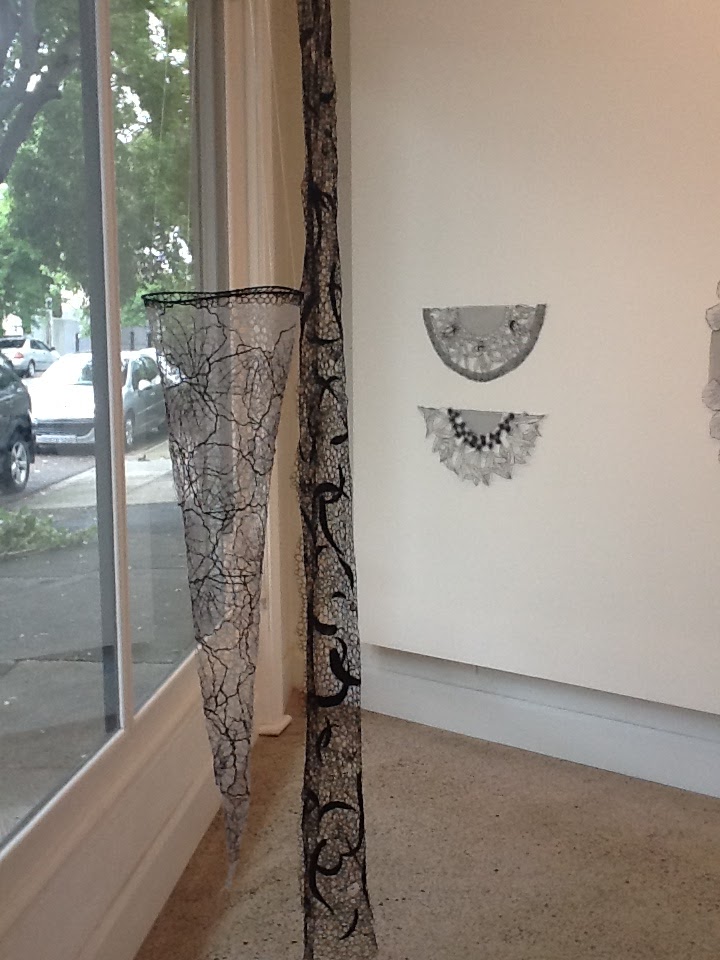
Last Friday fellow Canberran, Sharon Peoples, and I were in Sydney for the opening of our group exhibition, Here & There, together with shibori-artist extraordinaire, Barbara Rogers, at her gallery, Barometer, in Paddington.

Barbara Rogers (left) talking to Jane Burns at the Here & There opening
Here & There responds to the concept of time and place - of being in one geographical location whilst making work about a distant other - about our experiences of dislocation and displacement as artists.

For me, this occurred during my 3-month Asialink residency at Rimbun Dahan in Malaysia in 2013.  I was busy making work about Canberra for my exhibition Natural Wonders ( Narek Galleries in 2013in the heat and humidity of a tropical home-away-from-home. My thoughts about Canberra, in particular Pialligo and Aranda were more distilled and defined despite the thousands of kilometres between us. It seemed that distance enabled me to envision and articulate my thoughts on home with more clarity.
Seasonal Variations I-IV - Julie Ryder
For Sharon Peoples, her pilgrimage to Santiago di Compostella provided the inspiration for new work about walking and thinking, about slowing down to absorb the details of her immediate environment. This camino resulted in her solo exhibition Habitus ( Narek Galleries in 2014).  Sharon states that the word habitus can refer to 'second nature', and that for her embroidery is part of her identity - she embroiders every day. The repetitive and meditative nature of embroidery reflected her camino through Spain - in both walking and embroidering Sharon truly engaged her whole self.
Installation of Sharon People's work in Here &There
For Barbara Rogers, inspiration came from trips to Japan to investigate different methods of shibori. Over many years Barbara has experimented and refined her personal interpretation of carved board clamped resist shibori,  called itajime gasuri This technique results in an ikat-like patterning on woven cloth, however Roger's inspiration for this new body of work was found in Meisen silk kimono produced from the 1920's -1950's. Her modern interpretation is bold and graphic, which belies the complicated technique used to produce it.
Barbara Rogers' complex itajime gasuri
We were most fortunate to have Professor Jessica Hemmings officially open the exhibition. Jessica is in Australia for a short time to exhibit the Migrations exhibition (see previous post); to travel and speak in other institutions and to participate in DESIGN Canberra as part of Design Buzz as well as concentrating on writing...and running!
Jessica Hemmings (centre) with Barbara Rogers (L) and Sharon Peoples (R)
We thank her so much for her insightful comments during her opening speech and look forward to hearing her talk with indigenous designer, Lucy Simpson, as part of Design Buzz on 24th November.

Here & There continues until November 28th.
Opening Hours are 11 - 5pm,   Wednesday - Saturday

For those of you who can't make it to Sydney, we will be showing an extended version of Here & There at the Belconnen Arts Centre in April-May 2016